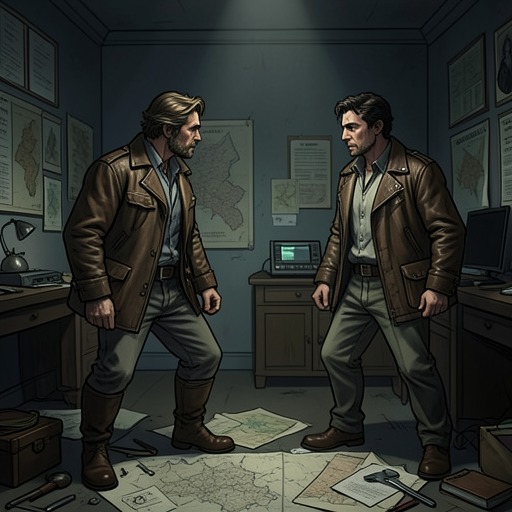
William Oh–Mason Lanover rivalry
The Legend of William OhWilliam Oh–Mason Lanover rivalry begins when Mason Lanover encounters a fellow Aspirant whose reputation seems manufactured, whose social influence exceeds his own, and whose abilities repeatedly contradict the image of an incapable orphan. Mason treats William Oh as a public fraud to be exposed; William, largely indifferent to Mason’s aristocratic indignation, answers the rivalry through blunt questions, improvised tactics, and acts of practical competence. Their conflict therefore links status, reputation, and survival: Mason wants to prove that William is not what others believe, while William keeps demonstrating that Mason’s contempt is a poor guide to reality.
Origins in Status and Reputation
Mason Lanover enters the rivalry as the heir of the Lanover fortune and a future Lord who expects his resources and social position to make him a natural first choice for a team. Instead, other Climbers repeatedly favor William Oh, leaving Mason as what he regards as everyone’s second choice. The humiliation is especially sharp because Mason believes he is genuinely substantial while William is merely performing an identity. His resentment is not casual teasing; it becomes a cold fury directed at the idea that an “obvious faker” can receive admiration that Mason considers his by right.
The immediate target of Mason’s suspicion is William’s reputation before his Establishing Quest. Mason believes William deliberately spread rumors about himself to attract girls, while June disputes the assumption that William created the stories and recalls that he appeared nervous rather than triumphant when placed at the center of attention. This disagreement exposes the rivalry’s central asymmetry: Mason interprets William’s popularity as calculated deception, whereas others can read the same attention as something William did not fully control. William’s public image has already begun separating from his intentions, and Mason responds to that uncertainty by treating exposure as a moral duty.
The Confrontation in the Abyss
Mason and his companions approach William during the expedition intending to establish that he is a fraud. Mason attacks him as a “spurious cad” and condemns the “well of pernicious lies” William has supposedly dug for himself, insisting that its present sweetness will eventually become poison. William’s response is characteristically literal: rather than debate the accusation, he asks what “spurious” means. The exchange turns Mason’s elaborate denunciation into an awkward display of vocabulary and class performance, making the supposed contest of intellect favor William’s plain practicality.
Mason clarifies that the group has come to prove William a charlatan and warn others, not to kill him, steal his equipment, and abandon him at the bottom of the abyss. The distinction matters because Mason wants the authority of an executioner without actually taking responsibility for murder. William, after confirming that his life and possessions are not the immediate objective, simply returns his attention to the expedition and informs Loth that the situation is clear. Mason’s rhetoric seeks to define the encounter; William’s refusal to treat it as important deprives the rhetoric of much of its force.
The rivalry becomes physical when William must climb out of the pit with one hand. Mason openly wonders how such a climb is possible, and Roger prepares to burn the rope after William begins moving. William instead runs up the rough stone wall like a “three-legged spider,” catches the rope two thirds of the way up, uses its rebound to reach the tunnel edge, and ends up clinging face-to-face with Mason. The feat does not merely refute Mason’s expectation; it reverses the scene’s hierarchy. The one-handed orphan whom Mason expects to expose becomes the faster climber, while Mason is reduced to watching and struggling to keep pace.
Competition Under Immediate Threat
The rivalry is interrupted by a Kaith attack, forcing Mason and William into a situation where survival overrides their original argument. When a barbed Kaith forelimb catches Mason’s boot, William uses his odd axe to chop it away. Mason immediately worries about bleeding and venom, but William’s ignorance of the danger makes the rescue almost absurdly unsentimental: William protects the man who came to discredit him without pausing to acknowledge the rivalry’s emotional stakes.
A moment later, a stinger catches William in the shoulder. His body stiffens, and he tumbles into the Kaith-filled pit. Mason rushes forward, declaring that he will not allow his legend to begin with a crippled man dying because Mason lost his composure. The wording still places William inside Mason’s self-conscious concern for his own legend, but the action marks a change in value: Mason’s desire to expose William gives way to an urgent need to keep him alive. June reports that William has been stung and fallen, while Reggie holds the tunnel with his shield; Mason then insists that Kaith venom only paralyzes and that Nathan may be able to retrieve William if they reach him quickly enough.
This episode does not resolve the rivalry, but it establishes its limits. Mason can resent William’s fame, challenge his authenticity, and imagine himself as the agent of his downfall; he cannot simply watch William die. William likewise does not answer Mason’s hostility with abandonment. Their relationship is competitive, but the dangers of the Climb repeatedly expose a harder bond beneath the posturing: each becomes an unwilling participant in the other’s survival.
Rivalry as a Contest of Evidence
Mason’s case against William is continually weakened by evidence that cannot be explained away as charm. William’s one-handed climbing, his ability to react under pressure, and his rescue of Mason all contradict Mason’s preferred picture of an empty fraud. Even when William’s public reputation becomes increasingly extravagant, the underlying facts remain formidable. Jason Salazar’s promotional stories describe impossible origins and superhuman powers, while later tavern rumors claim that William can become lightning, that his severed hand became a cursed talisman, or that he consumed a lightning bolt. These accounts are unreliable, but they grow from visible events and abilities, allowing rumor to magnify a real residue of competence.
Mason’s rivalry is thus also a struggle over interpretation. He is not wrong that William’s reputation has been inflated; Jason Salazar is explicitly performing the role of hype man, and the System later identifies William Oh only after several people attempt to claim his reward. Yet Mason mistakes exaggeration for total falsity. William can be both the subject of absurd stories and the person who actually crosses impossible terrain, survives Kaith attacks, and earns an exceptional performance rating. The conflict’s irony is that Mason’s demand for authenticity drives him toward a more distorted conclusion than the rumors themselves.
Consequences and Continuing Tension
William’s advancement makes Mason’s original complaint increasingly difficult to sustain. After the Establishing Quest, the System rates William’s performance as exceptional and grants him a reward roughly equivalent to Mason’s. William then receives a new quest to ascend to the Second Floor, having reached level five and ranking 1053rd among that year’s Aspirants. These formal recognitions give institutional weight to the accomplishments Mason had wanted to reduce to fraud and publicity.
The rivalry therefore ends this phase without a clean reconciliation or decisive victory. Mason’s hostility remains real, but his direct experience of William forces grudging respect into the relationship. William does not seek Mason’s approval and rarely treats his denunciations as worthy of extended argument; his actions instead create an accumulating record that Mason must confront. Their dynamic is best understood as an unstable contest between inherited status and demonstrated capability, between the story a person tells about himself and the evidence that survives when the abyss stops listening to speeches.